Latest Version
7.60
August 09, 2026
3Patti Pearl Studios
Games
Android
88 MB
0
FREE
com.biz.3pattifacebook.official
Report a Problem
More About 3 Patti Facebook APK Download – Verified Latest Version
The Download Button Doesn't Always Send You the Same File
Reading through this app's own install script turned up something that never shows up on the promotional page itself: the button doesn't point to one fixed file. Depending on a code attached to the link that brought you to the page, it quietly serves one of two differently-named builds hosted on the operator's own file server. Nothing on the page tells you this is happening — it only shows up in the script actually running the download. That single detail sets the tone for how this guide covers the rest of the app: checked against the code and the operator's own site, not repeated from a competing listing.
| What was checked | What it shows |
|---|---|
| File size | Approximately 88 MB, per the operator's own install page — one of the heaviest single downloads in this category |
| Minimum Android version | Android 5.0 or newer |
| Version number | Not published anywhere on the operator's own site |
| Download behavior | Serves one of two different builds depending on a channel code in the arriving link |
| iOS handling | A redirect line exists in the code but is commented out and inactive |
| Publisher | Same studio behind 3 Patti Pearl, under new branding |
Why an App Would Switch Files Based on a Link Code
This isn't unusual once you understand what it's typically used for — tracking which marketing channel or affiliate source actually drove a given install, by tagging the link and having the server respond accordingly. It's a reasonable, fairly ordinary technique on its own. What it means practically is that "the file this app installs" isn't a single fixed answer the way it is for most apps covered in this network — it genuinely depends on which specific link you tapped to get here.
It's also a useful reminder about how little of an app's actual behavior is visible from its promotional page alone. A landing page shows you a headline, a button, and a handful of screenshots — it says nothing about the logic sitting behind that button, which in this case branches based on a piece of data most visitors never notice is even present in the URL. That gap between what a page shows and what its code actually does is exactly why this guide checks the script directly rather than describing only what's visible on the surface.
What You're Actually Downloading
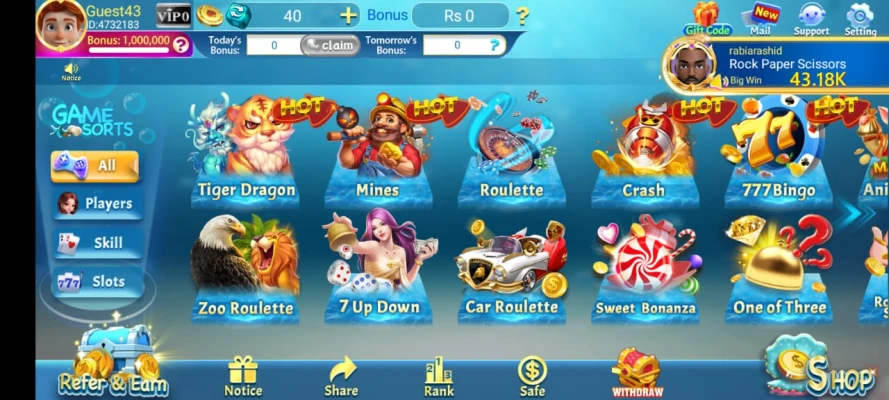
Underneath the tracking mechanics, this is a card-and-casino app built around 19 separate titles rather than one or two. Teen Patti and Dragon Tiger sit at the center, joined by Teen Patti 20, Best of Five, Baccarat and Blackjack on the card side; Roulette, Car Roulette and Zoo Roulette make up a separate roulette group; and a wider mix of Sweet Bonanza, Fruit Line, a Crash-style multiplier game, Mines, 777 Bingo, 7 Up Down, Animal Party, Direction Bounty, Poker Race, One of Three, and Rock Paper Scissors round the library out. Nineteen formats bundled into one install is a meaningful part of why the file lands at 88 MB rather than the 20-50 MB range several single-format competitors in this category run at — each format needs its own assets somewhere inside that download.
There's a genuine trade-off buried in a library this wide, worth naming rather than leaving implicit. An app built around a single game format can pour every update cycle into that one thing — tightening the table experience, fixing edge cases, refining the one interface players actually spend their time in. Spread the same-sized team across nineteen separate titles instead, and by definition each one gets a thinner slice of ongoing attention. That's not a criticism specific to this app so much as a mathematical reality of building broad instead of deep, and it's worth factoring in if what you actually want is one polished table rather than a wide menu of options.
A Disclaimer Worth Reading in Full
Sitting quietly in the footer of the operator's own site is a line most competing pages skip entirely: "3 Patti Facebook is not affiliated with or endorsed by Meta Platforms, Inc. The word 'Facebook' in our brand name refers to social card gaming context, not the Meta company." That's not boilerplate legal filler — it exists because the entire app is marketed around a social layer borrowing recognition from a specific, globally known brand name, and someone clearly decided that risk needed spelling out in writing rather than left implied.
The app's own FAQ is similarly specific about what that Facebook connection actually involves: only "basic Facebook profile information (name and profile picture)" gets accessed to show your identity to friends inside the app, with posts, messages, and other account data explicitly excluded per the operator's own statement. That's a concrete, checkable claim rather than a vague privacy promise — worth holding the app to directly if the permission screen you actually see ever asks for more than that.
It's worth thinking about why an app in this specific category would want a Facebook connection at all, rather than taking it as a given. Most competitors in this space run entirely anonymous accounts tied to a phone number, with no social identity attached beyond a username. Building the entire product around visible friend connections is a genuinely different strategy — it trades some of that anonymity for a stickier product, since a leaderboard and private tables only work if you can see who your friends are and they can see you. That trade-off is worth being conscious of specifically because it's unusual for the category, not because it's inherently a problem.
Same Studio, Different App: How This Relates to 3 Patti Pearl
This app is published by the same studio behind 3 Patti Pearl, released here under a completely different storefront rather than as a simple reskin. Pearl's own listing describes a single-format, pearl-themed Teen Patti game with no social features anywhere in its materials. This app takes a broader library and wraps it in friend lists, private tables, and a leaderboard system instead — a different front door built on top of infrastructure the studio had already proven with an earlier release. If you're choosing between the two, the deciding factor isn't which is more "real" — it's whether you want a social, friends-connected experience or a more anonymous single-game one.
It's worth naming what this pattern usually means in practice, since it isn't unique to this studio. Building the expensive part of an app like this — the real-time server infrastructure, the account and payment systems, the anti-cheat layer — is a one-time cost. Once that foundation exists, launching a second storefront under new branding is a comparatively cheap way to reach a different segment of players without rebuilding any of the hard parts from scratch. That's almost certainly the more likely explanation here than two completely independent products happening to share a publisher by coincidence.
Getting the APK Onto Your Phone
- Tap download and wait for the full 88 MB to finish saving — this app runs heavier than most in this category, so give it noticeably longer on a slow connection than you would a lighter competitor.
- Open the file from your notification shade, or locate it in your Downloads folder through a file manager if the notification has already cleared.
- Android will prompt for permission to install from this source, since the file didn't arrive through the Play Store. Grant it to whichever app opened the file — usually your browser — under Settings, then Apps, then Special app access, then Install unknown apps.
- Return to the install screen and finish the process. Given that this app's own download button can hand you one of two different files, check that the installed icon and name actually read "3 Patti Facebook" before opening it.
When the Install Doesn't Go Cleanly
A blocked install almost always traces back to the unknown-sources permission not being switched on yet — recheck it under your phone's security settings and try again. A download that keeps failing partway through given the larger 88 MB size is more often a connection issue than a broken file; switching networks and restarting from scratch tends to fix it faster than resuming a partial download. If storage is the complaint, budget at least 250-300 MB above the raw download size, since the installed app takes up more room once Android unpacks it. And if the app installs but crashes or won't open, that's usually a sign the download itself didn't finish cleanly — delete both the app and the file, then pull a fresh copy rather than repairing what's there.
Why the iPhone Button Doesn't Do Anything
Most apps in this category never wrote iOS handling at all. This one is different: the code for redirecting an iPhone visitor somewhere specific is actually present in the install script — it's just been commented out, meaning it's sitting there disabled rather than missing entirely. Whatever destination that line once pointed to is no longer reachable, and tapping download on an iPhone today produces exactly the same nothing-happens result as an app that never built iOS support in the first place. There's no official PC client either, and no browser-playable version — Android is the only platform this operator currently ships a working file to.
Private Tables, Leaderboards, and Sharing Wins
The social mechanics this app is built around, according to its own site: private tables that let you bring in up to five Facebook-connected friends for an exclusive game, a leaderboard ranked specifically against your own friend connections rather than the wider player base, one-tap sharing of a win to your Facebook timeline, and a referral bonus paid out when someone joins through your share and deposits.
One feature on the homepage is worth a skeptical read rather than a literal one: a live-updating activity ticker showing lines like a named player supposedly just winning a specific amount. This kind of widget is common across apps in this category as a way to create a sense of ongoing activity, and there's no way to independently verify any individual line in it — treat it as an interface design choice rather than a confirmed record of anyone's actual result.
The leaderboard mechanic is worth a closer look on its own terms too, separate from the activity ticker. Ranking against your own friend connections rather than the entire player base changes the psychology of the feature meaningfully — a global leaderboard is effectively unreachable for most players, while a leaderboard scoped to five or six people you actually know is something you can realistically climb. That's a deliberate design choice built around engagement within a small social circle, not a side effect, and it's the kind of feature that only makes sense once you understand the app is built around Facebook connections in the first place rather than bolted on afterward.
What the Welcome Bonus Actually Says
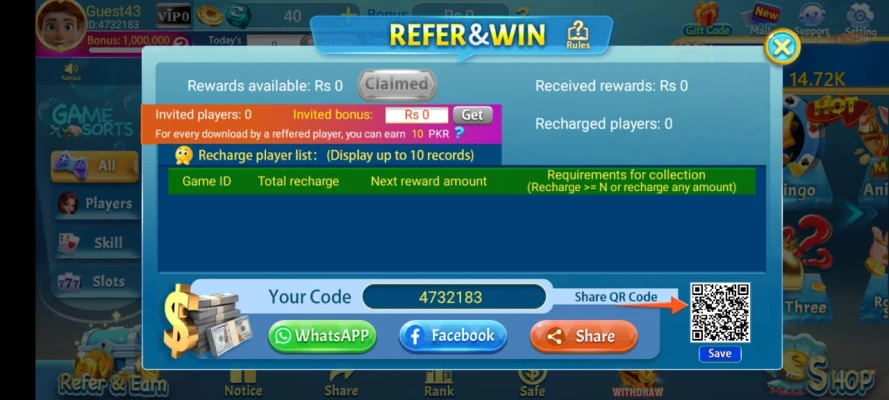
Per the operator's own site: new players get PKR 700 in bonus credit after completing registration and phone verification, usable across the game library, carrying a stated 5x wagering requirement before it can be withdrawn. A separate PKR 500 bonus is paid for each friend who joins through your referral and completes a first deposit. Both figures are specific rather than vague, which is worth something on its own — but exactly how the wagering requirement gets tracked and how fast a withdrawal actually clears once it's met isn't something independently tested here. Whatever the app itself states on its own account screen is the version worth trusting over any third-party page repeating these numbers, this one included.
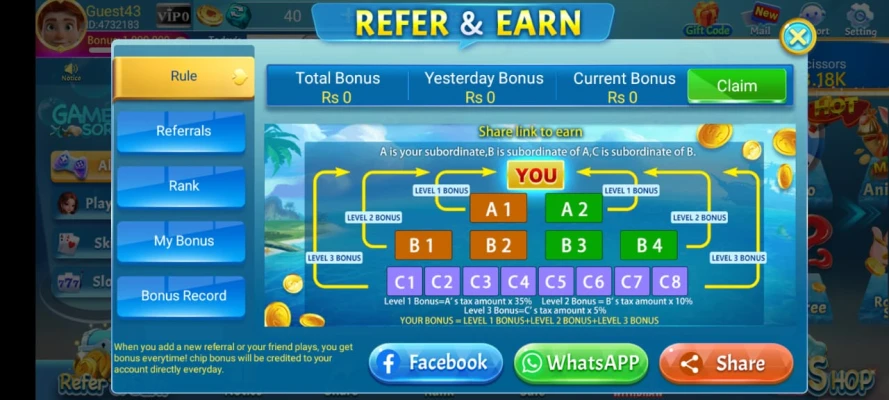
The referral structure deserves a second look too, since it's the mechanism tying the bonus system directly to the app's social pitch. Rather than a flat sign-up reward, the PKR 500 friend bonus only pays out once the invited friend actually deposits — meaning the incentive is built to reward friends who genuinely install and fund an account, not just click a link. That's a fairly standard structure for referral programs generally, but it's worth understanding the mechanism rather than assuming a bonus arrives the moment someone taps your invite.
A Small Sign of an Actively Maintained Site
The operator publishes a dated blog directly on the same domain as the download page, with posts on setting up private tables and the referral program timestamped March and April 2026 as of this check. A running series of dated posts is a small but genuine signal that this property is being kept up rather than left static after launch — harder to fake convincingly than a single unchanging landing page.
What This Page Didn't Check
Worth being direct about the boundary of what's actually confirmed here. The file itself wasn't opened or unpacked — no manifest, no permission list, no package name pulled from inside the APK. Everything above about the file comes from the operator's own install page and the install script that decides where the download button sends you, not from tearing the file apart. The bonus terms and the Facebook-permission claim likewise come from the operator's own stated FAQ, not from independently testing a deposit, a withdrawal, or an actual Facebook connection. None of that makes the app untrustworthy — it's simply the line between "checked directly" and "stated by the operator," and this guide keeps that line visible rather than blurring the two together.
Hacks and Predictors: Why None of Them Work
Every game in this library resolves on the operator's own server rather than on your device — your phone displays a result that's already been decided, with no local calculation for a hack to intercept and no pattern across independent rounds for a predictor to actually read. Anything sold as a hack or predictor for this app is either dead weight or built to do something to your phone rather than the game. Treat any file offered outside the app's own official channel with the same suspicion you'd give an unsolicited file from a stranger.
Before You Connect Any Account
A few habits worth applying here specifically. Only install from a link you've checked yourself — given the confirmed dual-file behavior, which file you get can genuinely depend on that. Watch the actual permission screen at the moment you connect your Facebook account, and confirm it matches the "name and profile picture only" claim in the app's own FAQ rather than assuming it automatically will. Keep your device's OS reasonably current, and trust your own instinct if the app's behavior after install doesn't line up with what's described here.
Given the social layer this app is built around, it's also worth thinking briefly about who ends up seeing what. Sharing a win to your Facebook timeline is opt-in per the operator's own description, not automatic — but it's worth confirming that setting yourself the first time you use the feature rather than assuming a default you haven't checked. The same goes for the friend list itself: understand who can see your activity inside a private table before assuming a "private" table is invisible to everyone outside the people you specifically invited.
Questions People Actually Ask About This App
Does this app belong to Facebook or Meta in any way?
No — the operator states this directly in its own footer, and explains the name refers to the social gaming concept rather than the company.
Why might I get a different file size than a friend who downloaded the same app?
Because the install script can serve one of two different builds depending on a channel code tied to the link used to reach the page — not a fixed single file.
What's the real file size?
Approximately 88 MB, according to the operator's own install page.
Can I install this on an iPhone?
No. A redirect for iPhone visitors exists in the code but has been disabled, so tapping download on iOS currently leads nowhere.
Who makes this app?
The same studio behind 3 Patti Pearl, here under a social-focused rebrand rather than a straight copy.
What does connecting Facebook actually share with the app?
Per the operator's own FAQ, only your name and profile picture — not posts, messages, or other account data.
Is the welcome bonus real money I can withdraw immediately?
It's PKR 700 in bonus credit with a stated 5x wagering requirement attached before withdrawal — read that requirement before assuming it's available instantly.
Should I trust the "someone just won" ticker on the homepage?
Treat it as a design element meant to suggest activity, not a verified record of any specific person's result.
Do hacks or predictor tools work on any of the 19 games?
No — every round is decided on the operator's server before your device shows a result.
What if my phone blocks the install?
Turn on the "install unknown apps" permission for your browser or file manager in your security settings, then try again.
How much storage should I clear before installing?
At least 250 to 300 MB beyond the 88 MB download itself, since the installed app takes up more space once Android unpacks it.
Does this page know exactly what's inside the file, like its permissions?
No — the file itself wasn't opened or unpacked. Everything here comes from the operator's own install page and script rather than a manifest teardown.
One Last Thing Before You Tap Download
Most of what's covered here doesn't show up anywhere in the app's own marketing — the dual-file download behavior, the disabled iOS code, the studio connection to Pearl. All three came from reading the actual script and cross-checking the operator's own claims rather than repeating what the landing page says about itself. Given that the file behind this download button genuinely isn't fixed, sourcing your link carefully matters a little more here than it does for a typical single-file app in this category.
Rate the App
User Reviews












Editor's Choice